The one & only cheese bread "Pão de Queijo"
A unique class on how to master the Brazilian cheese bread! not only delicious but also gluten-free
GLUTEN FREEBREAD
The Pass: Chef’s Summary
Authentic Brazilian Pão de Queijo relies on the precise gelatinization of fermented cassava starch and a high-moisture "scalded" dough technique to achieve its iconic aerated, chewy center and thin, crispy golden crust. This masterclass breaks down the 1:1.5 starch-to-liquid ratio and temperature controls essential for professional-grade results.
Why is Pão de Queijo more than just "cheese bread"?
Pão de Queijo is a technical marvel of Minas Gerais, utilizing a non-Newtonian dough made from fermented cassava starch rather than wheat flour. Unlike gluten-based breads, its structure comes from the pre-gelatinization of amylopectin molecules during the scalding process, resulting in a naturally gluten-free, elastic crumb that is uniquely synonymous with Brazilian hospitality.
This golden treasure was born in the 18th century in the state of Minas Gerais. During the Brazilian Gold Rush, wheat was scarce and expensive, forcing the mineiros to turn to the indigenous staple: the cassava root. By combining the leftover starch (polvilho) with the abundance of hardened artisanal cheeses from local farms, they created a survival food that eventually ascended to the pinnacle of global snack culture.
What is the secret of Polvilho Azedo vs. Doce?
The secret to the perfect "rise" in Pão de Queijo is the specific use of Polvilho Azedo (fermented/sour cassava starch), which undergoes a natural fermentation process that increases its expansion power. While Polvilho Doce (sweet starch) provides the characteristic "chew" and density, the Azedo variant acts as the primary leavening agent, creating the aerated pockets and "sour" depth of flavor.
In professional kitchens, we often use a blend—typically a 50/50 or 60/40 ratio favoring the sour starch—to balance the expansion with structural integrity. You can deep-dive into the biological properties of the Cassava root to understand how these starches behave under heat.
Why does the "scalding" technique matter?
Scalding, or escaldar, involves pouring a boiling mixture of oil, water, and salt directly into the raw starch to partially cook the granules before the eggs and cheese are added. This step is non-negotiable because it creates a "pre-gel" that allows the dough to hold moisture and air, which then turns into steam during baking to provide the internal lift.
If you skip the scald, your bread will be flat, dense, and gritty. For a masterclass demonstration, watch Brazilian Kitchen Abroad .
The Executive Recipe: Pão de Queijo de Minas
Yields: 30-35 rolls | Prep time: 20 mins | Bake time: 25 mins
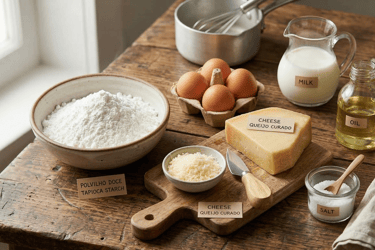
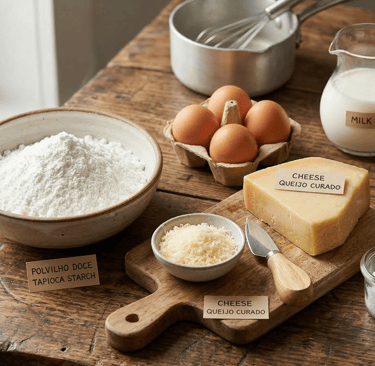
The Mise en Place (Ingredients):
500g (approx. 4 cups) blend of Polvilho Azedo and Polvilho Doce
250ml (1 cup) Whole Milk
100ml (1/2 cup) Neutral Oil (Grape seed or Sunflower)
100ml (1/2 cup) Water
10g (1.5 tsp) Fine Sea Salt
2 to 3 Large Organic Eggs (Added one by one to control hydration)
250g (2.5 cups) Grated Queijo Meia Cura or Parmesan (Sharpness is key)
The Execution (Instructions):
The Scald: In a heavy-bottomed saucepan, combine milk, water, oil, and salt. Bring to a rolling boil (exactly 212°F / 100°C).
The Hydration: Place the starch blend in a stand mixer bowl. With the paddle attachment on low, slowly stream in the boiling liquid. Mix until the dough resembles a thick, shaggy paste.
The Cooling Phase: This is where most amateurs fail. Let the dough rest until it reaches room temperature (approx. 15 minutes). Adding eggs to a hot dough will cook them instantly, ruining the emulsion.
The Incorporation: Add eggs one by one. The dough will look like it’s breaking—keep mixing until it is smooth and very sticky.
The Cheese: Fold in the grated cheese. In Brazil, legendary chefs like Helena Rizzo at Maní emphasize using high-quality, aged artisanal cheeses for that deep umami finish.
The Shaping: Lightly oil your hands. Roll into 30g (1 oz) spheres.
The Bake: Preheat your oven to 375°F (190°C). Bake for 22-25 minutes until they are puffed and light gold.
How do you fix a dough that is too sticky?
A common mistake on the line is adding more starch when the dough feels too wet; instead, you should chill the dough for 30 minutes to allow the starch to fully hydrate. Because cassava starch is highly hydroscopic, the "stickiness" is often just a sign of high moisture content, which is exactly what you need for the steam-powered rise in the oven.
Pro-Tip: If the dough is unmanageable even after chilling, use two oiled spoons to "drop" the dough onto the baking sheet rather than rolling it.
What is the best cheese for a sharp flavor profile?
While the traditional Queijo de Minas is hard to find abroad, a professional substitute is a mix of Pecorino Romano (for salinity) and Aged White Cheddar (for fat content and melt). The cheese should be finely grated so it distributes evenly through the starch matrix, ensuring every bite has a "velvety" cheese pull.
How can you tell when they are perfectly baked?
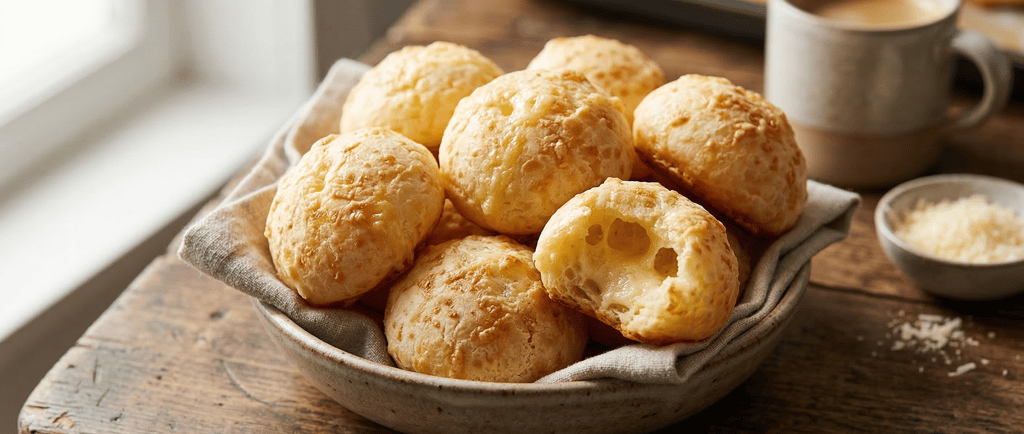
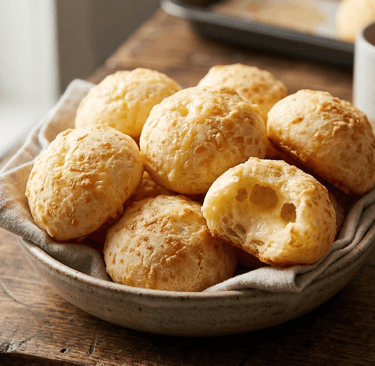
A perfectly baked Pão de Queijo should sound hollow when tapped on the bottom and have a "crispy" exterior that shatters slightly before revealing the "chewy, aerated" interior. If they collapse after leaving the oven, it means they were underbaked and the internal steam escaped before the starch structure could set.
Troubleshooting & Chef's Tips
The Bottoms are Burning: Your oven rack is too low. Move to the center position and use a silicone baking mat (Silpat) to insulate the starch.
The Rolls are Hard as Rocks: You likely overmixed the dough after adding the eggs or used too much starch-to-liquid. Aim for a 60% hydration level.
Freezing for Service: These are best baked from frozen. Flash-freeze the raw balls on a tray, then bag them. Bake at 350°F for 30 minutes—no thawing required.
Frequently Asked Questions (FAQ)
Can I use Tapioca Flour instead of Polvilho?
Yes, tapioca flour is the same as Polvilho Doce. However, for the authentic Brazilian "puff" and sour tang, you must include at least 50% Polvilho Azedo. Using only tapioca flour will result in a much denser, smaller, and less flavorful roll.
Why did my Pão de Queijo explode in the oven?
Explosions usually happen when the oven temperature is too high (above 400°F) or there are large air pockets trapped during hand-rolling. The rapid steam expansion ruptures the crust before it has a chance to stretch. Stick to 375°F for a controlled, even rise.
How long does the baked bread stay fresh?
Pão de Queijo has a very short "shelf life" of about 2 to 4 hours. Because it lacks gluten and fat-based preservatives, the starch begins to retrogradate (harden) as it cools. Always serve them "piping hot" straight from the oven for the best texture.
Is it possible to make this vegan?
It is difficult because eggs provide the protein structure that holds the steam. However, professional vegan versions often use a "flax egg" combined with nutritional yeast and a higher ratio of oil to mimic the richness and elasticity of the traditional mineiro recipe.